
Sonali Nakshine
25 Aug 2025 • 10:16 IST Follow Us
Joint Declaration by SCO Member States
Statement of Solidarity
“The Member States strongly condemned the terrorist attack in Pahalgam on 22 April 2025. They expressed their deepest sympathy and condolences to the families of the dead and the wounded. They further stated that perpetrators, organizers and sponsors of such attacks must be brought to justice.”
The declaration marks a rare moment of convergence on terrorism among SCO nations, especially given the geopolitical diversity and security interests of members such as India, China, Russia, Pakistan, and Central Asian republics. The Pahalgam attack, which claimed 26 civilian lives, has reignited debates about cross-border terrorism and state complicity in harboring extremist elements.
On Sovereignty and Counter-Terrorism
“The Member States, while reaffirming their firm commitment to the fight against terrorism, separatism, and extremism, stress the inadmissibility of attempts to use terrorist, separatist and extremist groups for mercenary purposes. They recognize the leading role of sovereign States and their competent authorities in countering terrorist and extremist threats.”
This clause addresses concerns about non-state actors being used as proxies in regional conflicts. It implicitly acknowledges the risks of geopolitical interference and proxy warfare, particularly in South Asia. While the statement is non-specific, analysts believe it was drafted to balance India’s firm stance on cross-border terrorism with sensitivities around Pakistan’s SCO membership.
- China and Turkey joined others in expressing condolences, indicating growing consensus within the SCO framework on terrorism-related issues.
- The declaration reinforced multilateral commitment to justice and counter-terror frameworks under the UN charter.
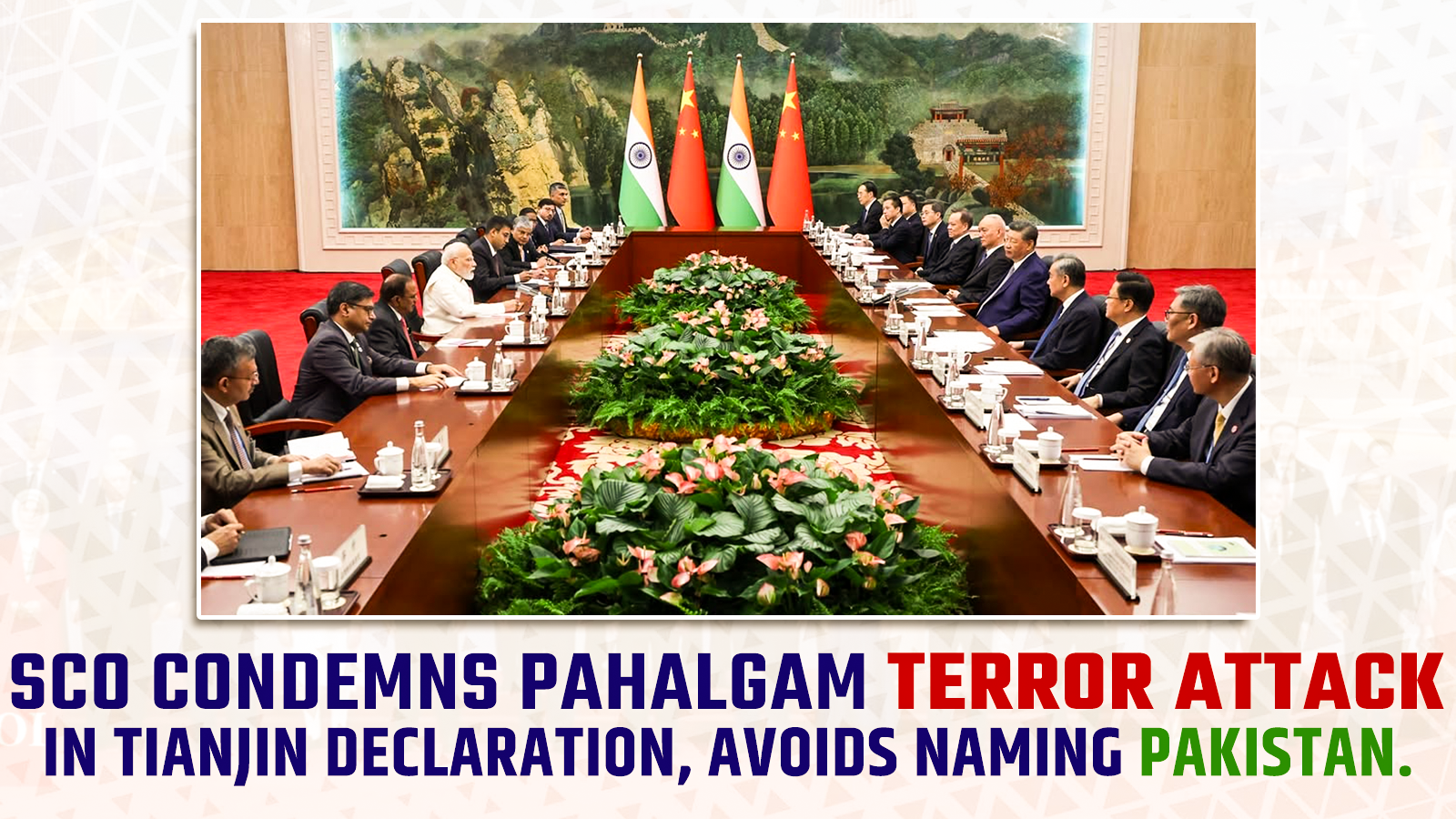
- Despite India’s diplomatic push, the document refrained from naming Pakistan, reflecting the bloc’s tendency toward neutral language in intra-member disputes.
PM Modi’s Address at SCO Plenary Session
Call for Global Unity Against Terror
“We have to say clearly and unanimously that no double standards are acceptable on terrorism.”
PM Modi used the platform to highlight the moral inconsistency in how different nations approach terrorism. He emphasized that selective condemnation based on political convenience only emboldens violent actors. His remarks were widely interpreted as a veiled rebuke to Pakistan and its alleged support for terror groups operating in Kashmir.
On the Pahalgam Attack
“This attack (Pahalgam) was an open challenge to every country and person who believes in humanity.”
Modi described the Pahalgam tragedy as a humanitarian crisis that transcends borders, urging SCO members to respond not as individual states, but as a united front. He added that the world cannot afford to turn a blind eye to atrocities simply because of political alliances or economic interests.
Questioning Terror Support
“In such a situation, it is natural to raise the question of whether the open support of terrorism by some countries can be acceptable to us. We have to unanimously oppose terrorism in every form and colour. This is our duty towards humanity.”
Modi’s comments, made in the presence of Pakistani PM Shehbaz Sharif, drew significant attention. Though no country was named, his words carried unmistakable weight. Observers noted the diplomatic tightrope walked by India—assertive in tone but restrained in delivery, aiming to pressure without provoking open confrontation within the SCO.
Summary
This report captures the essence of the SCO’s Tianjin Declaration and PM Modi’s firm but diplomatic messaging. The summit highlighted the growing realization among Asian powers of the need for a unified stance on terrorism, while also exposing the limitations of multilateral diplomacy in politically sensitive matters.
- Strong condemnation of the Pahalgam terror attack—one of the deadliest in recent years.
- Affirmation of collective responsibility in combating terrorism, though careful not to name offending states.
- PM Modi's intervention was seen as instrumental in pushing the inclusion of the Pahalgam reference in the final declaration.
- SCO’s cautious language reflects its commitment to unity over confrontation, especially on contentious issues like terrorism.
- Strategic takeaway: India’s growing influence within SCO and its effective use of diplomacy to spotlight cross-border terrorism.